By
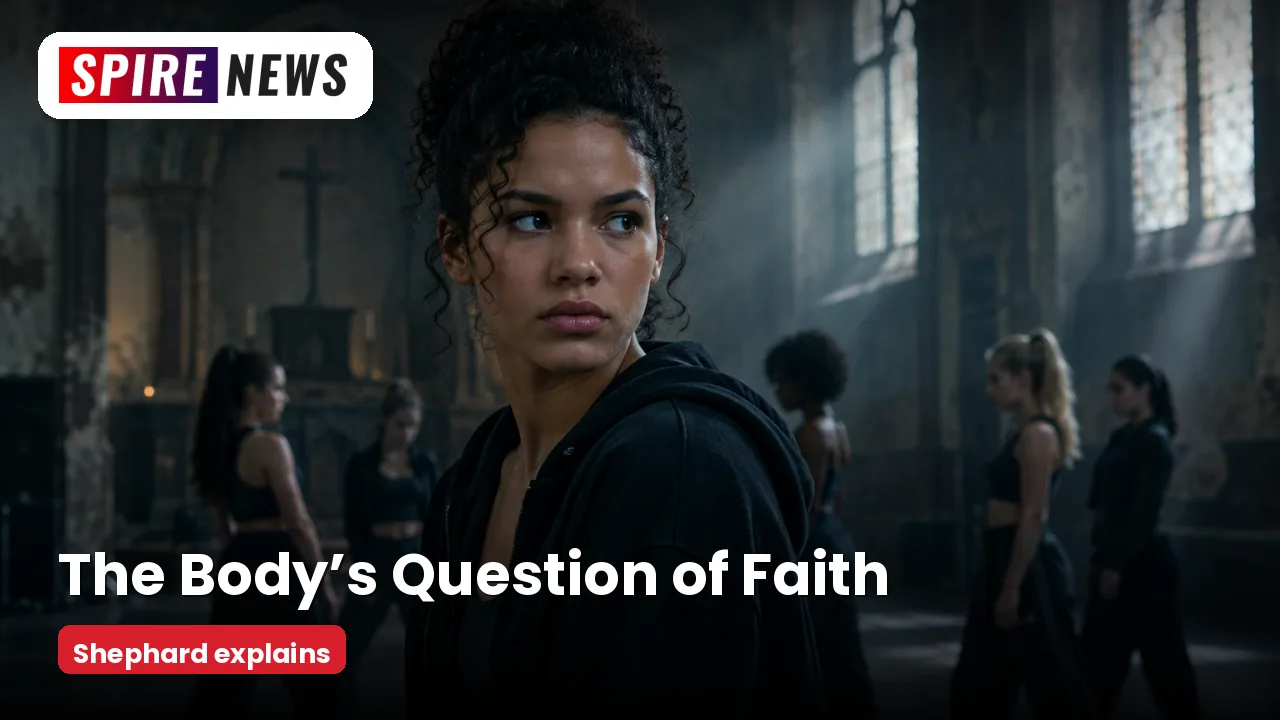
Netflix’s The Body begins with a Catholic school dance team and grows into a story about a town’s apparent spiritual experiences. But creator Quinn Shephard says there is one question the drama is not designed to settle: whether God is real in its world.
“If we ever fully defined it, it would break the rule of the show,” Shephard told Variety. The creator’s approach leaves room for viewers to draw their own conclusions, even as the series shows them how some of the claims at the heart of the story begin.
That distinction is important to understanding both Grace’s crisis and the dancers’ relationships. The audience sees choices that others in the town do not, but those choices do not resolve every question about faith.
How Grace’s crisis changes the dance team
Spoilers ahead for The Body.
Grace, played by Sofia Wylie, is a devout Catholic and a standout at dance-team tryouts. Her skill and rule-following manner draw resentment from some senior dancers. At a Halloween party in an abandoned convent, co-captain Elise, played by Sara Boustany, pressures Grace to take Ecstasy during a mock ritual.
Grace wanders off, and Anya and Lisbeth find her convulsing. Anya, played by Kristina Bogic, is the team’s other co-captain; Lisbeth, played by Geena Meszaros, is a new girl who had been rejected from the team in Grace’s favor. The two try to take Grace to a hospital, but she appears to die on the way.
Their next decision is shaped by what each stands to lose or gain. Anya supplied the Ecstasy and fears getting into trouble. Lisbeth sees a chance to get closer to Anya and join the team. They take Grace home instead and use her phone to suggest she arrived safely.
Grace takes a breath at the end of the first episode and spends the rest of the season in a coma. Anya brings Lisbeth onto the team in her place, turning Grace’s absence into an opportunity for the girl who helped conceal what happened.
The consequences extend beyond the team’s lineup. Elise fakes a vision of Grace, and other dancers subsequently fake visions too. The town comes to believe Grace has been chosen by God to perform healing miracles.
Viewers therefore have information the wider town does not: some of the visions are invented. That makes the dancers’ actions part of the story of how the belief spreads, rather than simply a mystery about what they have seen.
It does not, however, settle the broader supernatural question. The difference between exposing a particular false vision and proving or disproving God’s existence is central to Shephard’s explanation of the show’s ambiguity.
Faith and desire in the dancers’ lives
Shephard describes that ambiguity as a way to reflect different relationships with belief. “The show is meant to mimic faith, so there’s people who believe, there’s people who don’t and there’s people in the middle, like me, who are like, ‘I don’t know,’” the creator said.
Shephard is a lesbian who was raised in the church and later stepped away without fully rejecting it. That background gives context to a series concerned with faith in the lives of young women, including queer characters. The creator’s account also explains why uncertainty is a position the show makes room for, rather than a problem it necessarily needs to solve.
The dance team’s relationships add another dimension to those questions of identity. Anya and Elise are in love and were sexually involved at the Halloween party, yet Anya insists she is straight and loyal to her boyfriend, Steven. What she says about herself sits alongside a relationship that complicates that description.
The tension is different from the secret surrounding Grace. Anya and Lisbeth make a choice about what to conceal after the party; Anya’s insistence that she is straight concerns how she describes her own identity. Both, however, place the dancers’ private lives alongside the public story the town comes to believe.
For viewers looking for a definitive answer to the religious mystery, Shephard’s comments point instead toward the space between those perspectives: what the dancers know, what their community believes and what remains open to interpretation.