By
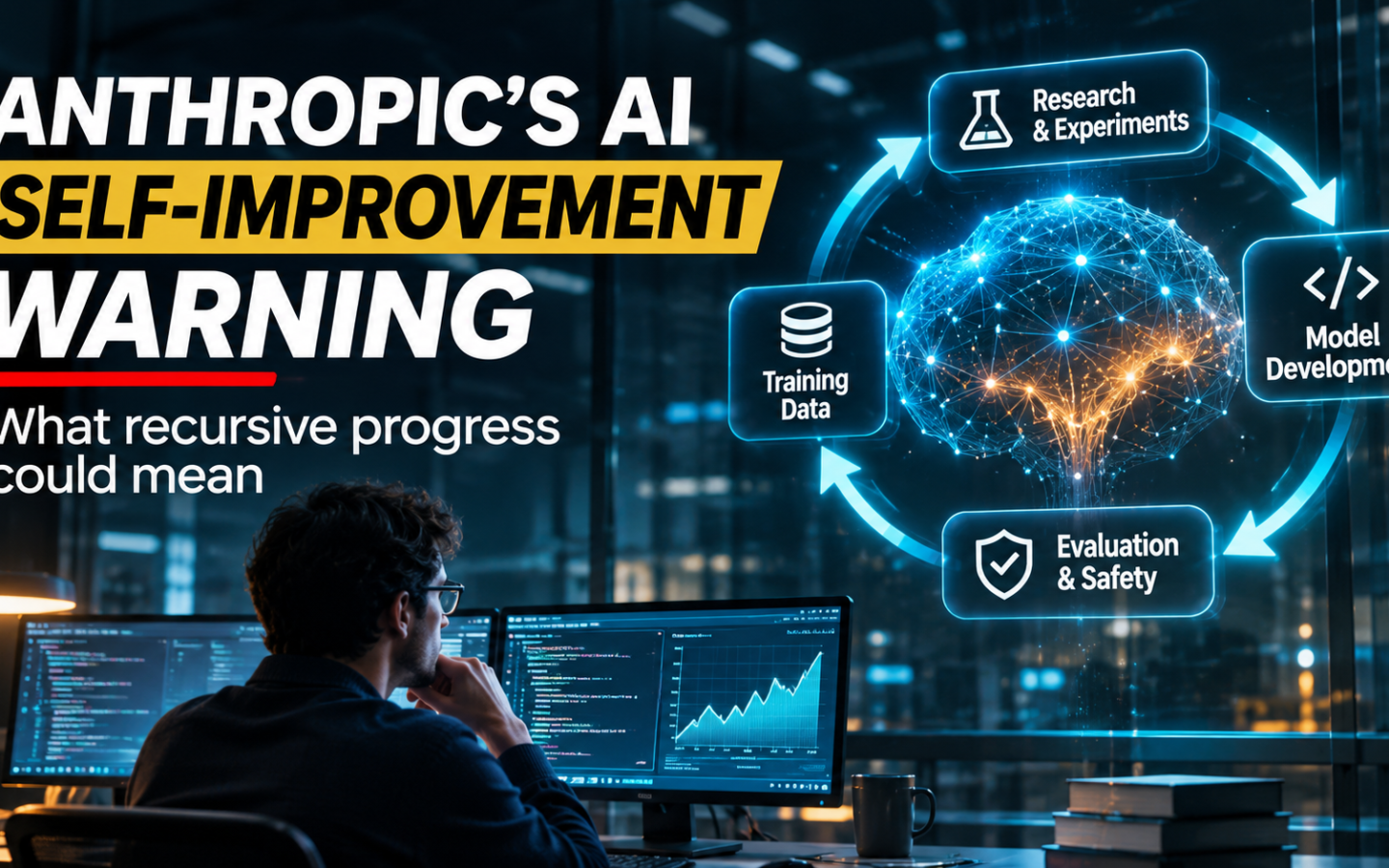
Anthropic says it may be approaching a major threshold in artificial intelligence: a point at which AI systems help accelerate the research and development of the next generation of AI. The company disclosed the possibility in an amended registration statement filed with the US Securities and Exchange Commission on November 2, while stressing that none of its current models has been designated as having crossed the threshold.
The disclosure has drawn attention because it describes a feedback loop in which increasingly capable models contribute to building their successors. Researchers often discuss the broader idea as recursive self-improvement (RSI). Anthropic uses a more specific term in its Responsible Scaling Policy: “dramatically accelerated progress attributable to AI.”
What Anthropic disclosed in its latest SEC filing
In the risk factors of its amended Form S-1/A, Anthropic says its internal estimates and expectations about future models indicate that it may “imminently” meet the relevant capability threshold. The company is careful to distinguish that forecast from the capabilities of models available today: it says it has not designated any current model as exceeding the threshold and is continuing to assess the underlying data.
The filing also warns that using AI to accelerate AI research could cause model capabilities to advance faster than the company’s ability to develop, validate and implement corresponding safety, alignment and security measures. Anthropic says it has previously failed to recognise a significant acceleration in its development rate until after it had occurred.
That is a risk disclosure, not an announcement that Anthropic has built an AI system capable of independently designing and training its own successor. The distinction matters: the company is describing a possible near-term threshold based on future-model expectations, not confirming that full autonomous self-improvement has already arrived.
How Claude is already helping build future models
Anthropic describes an existing process it calls “closing the loop.” Its filing says Claude is used in multiple parts of research, training and testing for subsequent model generations. Those tasks include running experiments, generating and processing training data, automating evaluations and safety audits, and writing and reviewing code.
The proposed cycle is straightforward. A more capable model can help researchers perform parts of AI development more effectively. That work can improve the next model, which may then assist with a larger share of subsequent research and engineering. Anthropic says this dynamic also helps its researchers identify improvements in computing efficiency, allowing more capable models to be trained and deployed with available resources.
AI assistance in research is not the same as a system independently setting its own goals, designing a new architecture, acquiring compute and deploying a successor without meaningful human direction. Anthropic’s filing does not say that this level of autonomy has been achieved.
Why recursive self-improvement matters
Recursive self-improvement describes a potential feedback loop in which an AI system contributes to improvements in the systems that follow it. If each generation becomes better at helping develop the next, progress could accelerate beyond the pace achieved through human-led research alone.
There is a potential upside. AI tools could help researchers test ideas, find software or hardware efficiencies, analyse scientific data and run evaluations faster. Faster research cycles could contribute to advances in areas such as medicine, materials science and engineering.
The concern is that capability gains could outpace the work needed to understand and control increasingly powerful systems. Safety testing, alignment research, cybersecurity protections and oversight may become harder if development accelerates faster than the safeguards designed to manage it.
Anthropic says human oversight remains necessary
Anthropic says it does not anticipate being able to safely use Claude to fully and autonomously design and build successive generations of frontier models without meaningful human supervision or understanding, even if that becomes technically possible.
The company says it is considering updates to its Responsible Scaling Policy to keep humans in control of frontier model development. Its filing also describes the possibility that capabilities could advance faster than the company’s safety, alignment and security measures, potentially increasing the risk of safety incidents or regulatory intervention.
Those statements are important because Anthropic has built its public identity around AI safety. The disclosure gives investors and the public a more concrete description of how the company’s own use of AI in research could create both a competitive advantage and a governance challenge.
The disclosure arrives as Anthropic prepares for an IPO
The RSI language appeared in an amended S-1/A filed on November 2 as Anthropic moves forward with its proposed public listing. The same filing provides investors with updated information about the company’s finances, infrastructure commitments and operating risks.
Reuters reported that Anthropic’s third-quarter revenue rose 47% from the previous quarter to $16.96 billion, while the company also disclosed substantial commitments to future computing capacity. The financial disclosures underline the scale of the infrastructure required to develop and operate frontier AI systems.
For investors, the question is not simply how quickly Claude’s capabilities may improve. It is also whether Anthropic can translate those advances into sustainable growth while maintaining the computing resources, safety systems and human oversight needed to support them.
What happens next?
Anthropic says it is continuing to assess the data behind its future-model expectations and is considering changes to its safety policy. The company has not announced that a current Claude model has crossed its defined threshold for dramatically accelerated AI-driven progress.
The next meaningful signals will be any updated Responsible Scaling Policy, further disclosures about how AI is used in model research, and evidence about whether the company can keep safety evaluations and human oversight aligned with faster development.
For now, the most accurate reading is that Anthropic believes AI-assisted research could soon reach a significant acceleration point. It is a consequential warning about the direction of frontier AI development, but it is not proof that fully autonomous, self-improving AI has arrived.