By
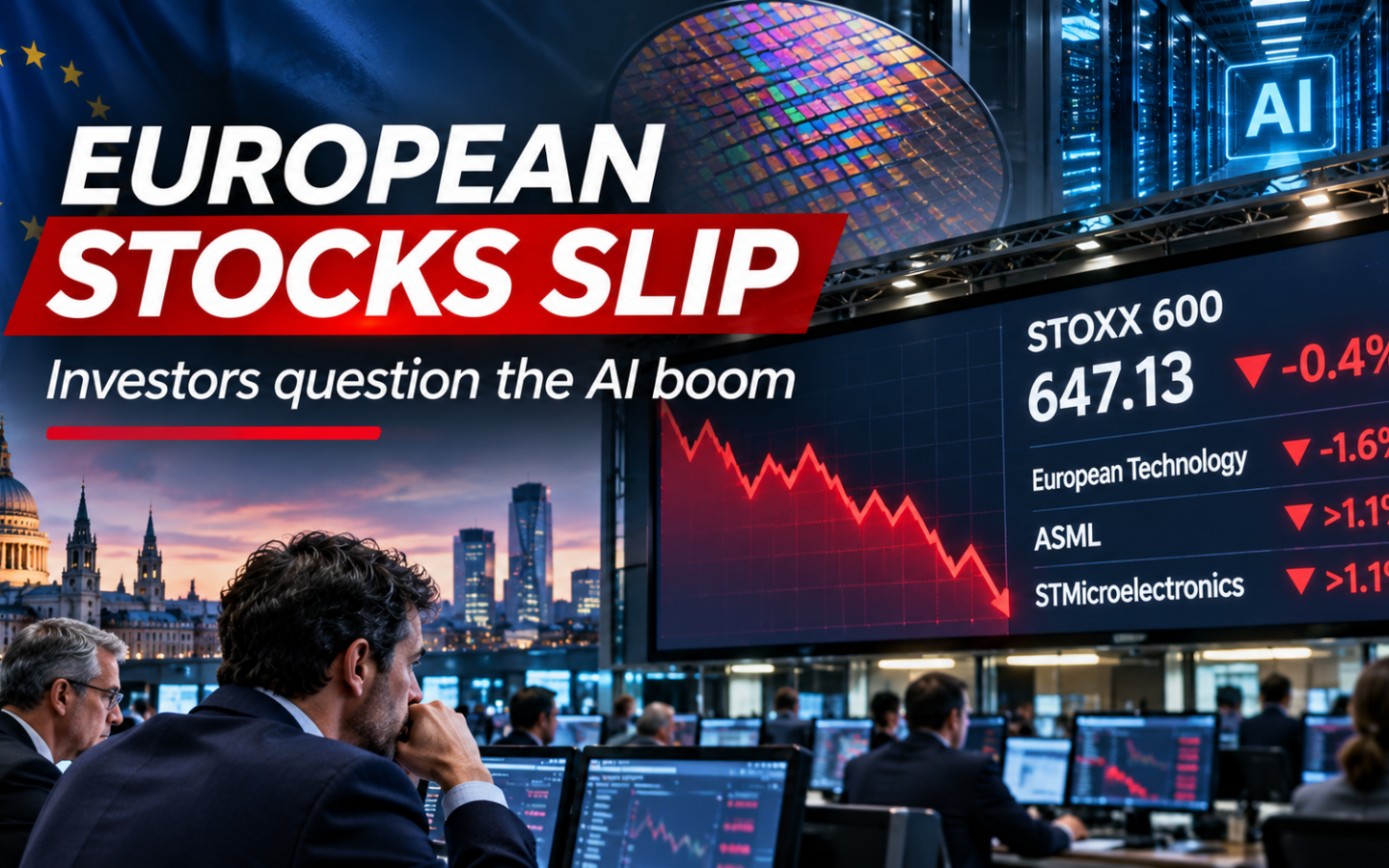
European shares edged lower on Tuesday as technology stocks came under pressure from renewed doubts about the sustainability of the global artificial intelligence rally. Investors reassessed whether the enormous sums being committed to AI infrastructure can generate returns quickly enough to justify current valuations, with chipmakers among the biggest drags on the market.
The pan-European STOXX 600 was down 0.4% at 647.13 points by 0955 GMT on 3 November, according to Reuters. The technology sector fell 1.6%, while shares in chip equipment makers ASML and STMicroelectronics each lost more than 1.1%. The decline came as markets reacted to disappointing results from major US hyperscalers in the previous week and Apple’s cautious forecast for holiday-quarter gross margins.
AI spending is facing tougher questions from investors
The central concern is no longer simply whether demand for AI computing exists. Investors are increasingly focused on how quickly that demand can translate into revenue, profits and cash flow for the companies building the infrastructure.
Technology groups have committed hundreds of billions of dollars to data centres, advanced chips, networking equipment and power capacity. Those investments are intended to support the next generation of AI services, but the infrastructure is expensive and takes time to build. If customer demand, pricing or productivity gains fall short of expectations, the financial returns could arrive later—or prove smaller—than markets have assumed.
That tension has become more visible after recent earnings from major US cloud and technology companies. Reuters reported that disappointing results from hyperscalers, combined with Apple’s weaker holiday-quarter gross-margin outlook, added to investor caution. The reaction has spread beyond US technology shares to European suppliers that are closely linked to the global semiconductor investment cycle.
European chipmakers feel the pressure
ASML is a key supplier of advanced lithography equipment used in semiconductor manufacturing. STMicroelectronics also operates in a sector exposed to the wider electronics and computing cycle. When investors become less confident about the pace or profitability of future AI infrastructure spending, companies connected to the chip supply chain can come under pressure even if their own businesses have not reported a fresh deterioration.
The latest move follows a broader period of volatility for European semiconductor stocks. On 30 October, Reuters reported that the European technology sector had fallen sharply after results from Amazon and Intel renewed questions about the cost of AI infrastructure and the timeline for returns. ASML and several other chip-related names were among the shares hit in that session.
Tuesday’s decline does not establish that AI demand is collapsing. It reflects a market reassessing the valuation and financing assumptions attached to the investment boom. Chip equipment orders, data-centre construction plans and cloud spending will remain important indicators for investors trying to judge whether the current cycle can be sustained.
Not all European investors see an AI bubble
The market reaction has not been uniform. Gilles Guibout, head of European equities at BNP Paribas Asset Management, told Reuters that European valuations had cooled while earnings dynamics remained positive. He argued that demand for computing should continue to support investment.
That view highlights an important distinction between concern about the price investors are paying for AI-linked stocks and concern about the underlying technology market. Companies may continue to buy computing capacity and deploy AI even if some listed suppliers experience a valuation reset. The debate is about the pace, profitability and distribution of those gains—not necessarily whether AI adoption will continue.
There were also notable gainers in Tuesday’s European session. Drax rose after announcing a data-centre project with Brookfield and Radiant that could attract more than £20 billion, while Bayer advanced after raising its 2026 profit forecast. Those moves show that investors were still responding to company-specific developments even as the broader technology sector weakened.
Debt and energy costs add to the market’s unease
The AI investment cycle is also unfolding against a difficult macroeconomic backdrop. A separate Reuters analysis published on 3 November said global markets were already vulnerable to rising sovereign borrowing costs, geopolitical tensions and trade uncertainty. The analysis noted that the scale of AI-related capital spending and the growing use of debt to finance infrastructure could amplify market stress if interest rates remain elevated.
For European investors, the exposure extends beyond technology shares. Large-scale data centres require reliable electricity, grid connections, land and cooling capacity. Their construction can create opportunities for utilities and infrastructure companies, but it can also increase financing needs and intensify competition for power. The economics of these projects will depend on utilisation rates, electricity prices and the ability of operators to secure long-term customers.
Tuesday’s trading was also affected by wider geopolitical risk. Reuters reported that escalating tensions in the Middle East and a rebound in oil prices weighed on risk appetite, meaning the market’s decline cannot be attributed to AI concerns alone.
What investors will watch next
Investors are likely to focus on several signals in the coming weeks: capital-expenditure guidance from major cloud providers, evidence that AI services are generating recurring revenue, chip demand and order trends, and the financing costs of new data-centre projects. Companies that can demonstrate measurable productivity gains or strong customer demand may be better positioned than those relying mainly on expectations of future growth.
For Europe, the performance of semiconductor suppliers such as ASML and STMicroelectronics will remain an important indicator of sentiment toward the global AI buildout. But their share prices will also be influenced by broader factors, including the semiconductor cycle, export restrictions, currency movements and the outlook for industrial demand.
The latest pullback is therefore better understood as a test of investor expectations than as proof that the AI boom is over. The technology may continue to expand rapidly, but markets are demanding clearer evidence that extraordinary investment will produce extraordinary returns.
Follow more market and technology coverage in Spire News’ Business & Finance section and Technology coverage.